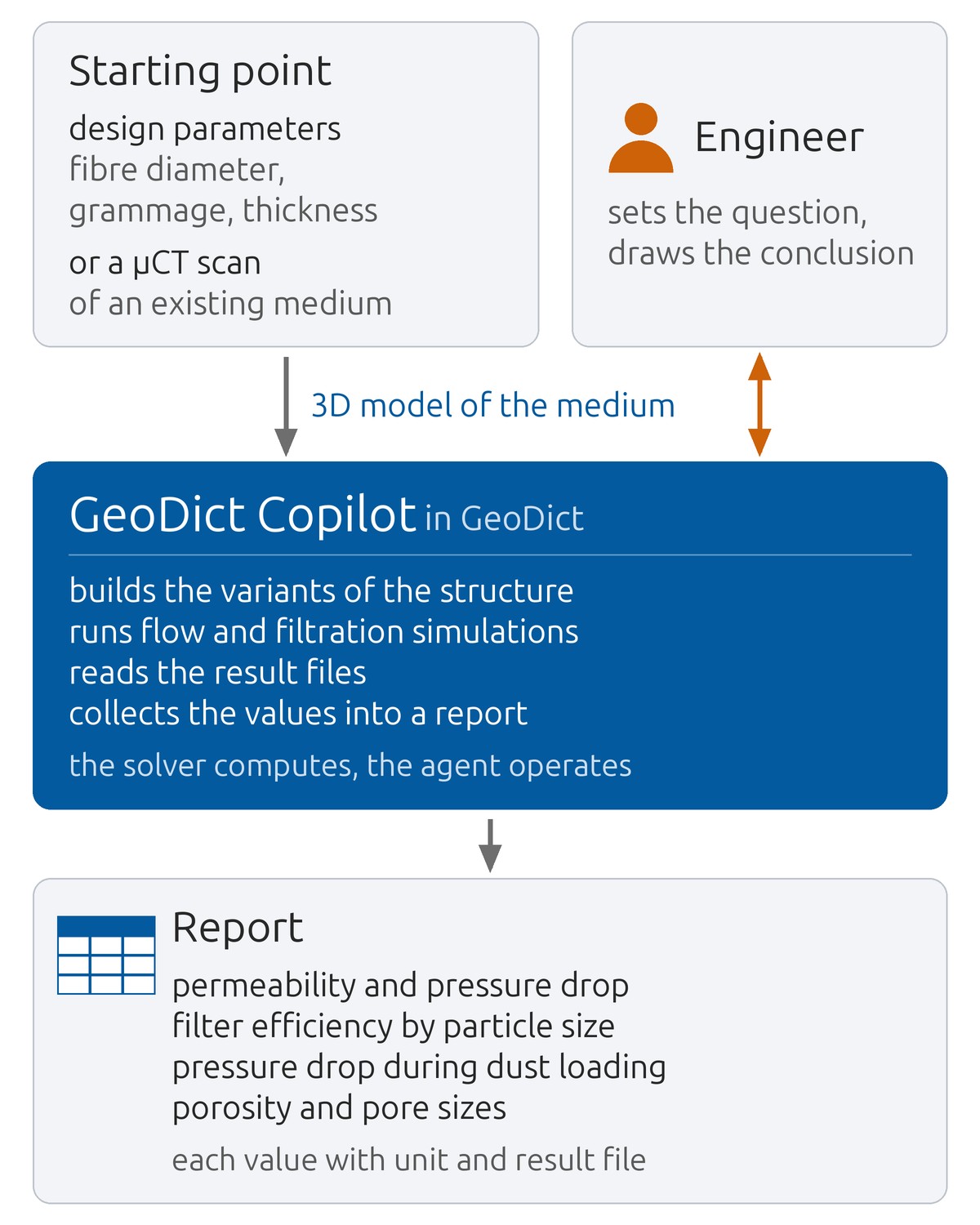
A new filter medium or nonwoven is usually developed by making samples and testing them, round by round. cvt engineering supports this development with microstructure simulation in GeoDict, the software for digital material R&D by Math2Market: pressure drop and filter efficiency are computed on a 3D model of the medium before a sample exists. For these studies cvt engineering uses the GeoDict Copilot, its AI agent for GeoDict; the engineer sets the question and checks the results.
Results of a study
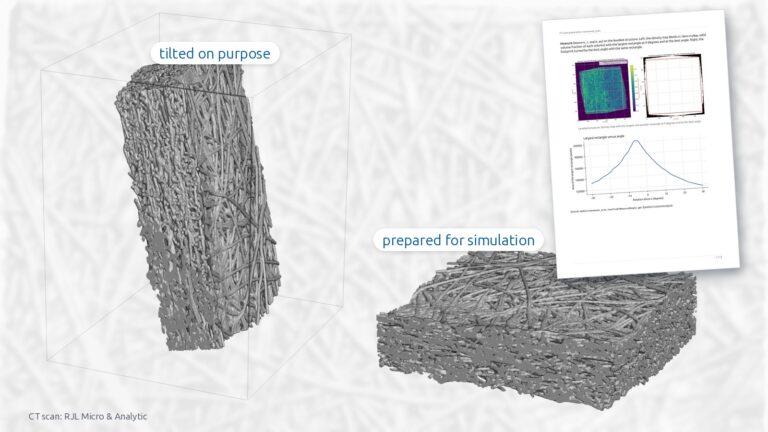
- Permeability and pressure drop of a medium, from design parameters or from a µCT scan.
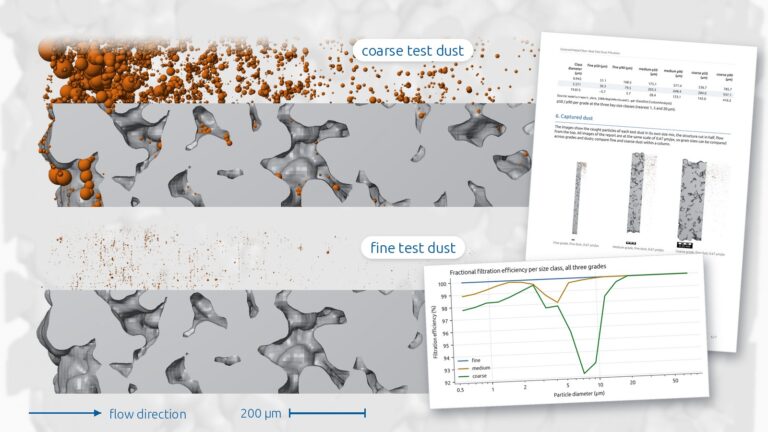
- Filter efficiency by particle size and the rise of pressure drop during dust loading.
- Porosity and pore sizes, also as a profile through the thickness.
- Variants compared in one study, for example in fibre diameter, grammage and thickness.
- A report with the assumptions and the result file of each value, and macros that run again in GeoDict.
AI agent and physical simulation
The solver computes the properties from the structure of the medium. The AI agent builds the structures, starts the runs and collects the values into the report. Trained models that predict properties from process or test data, and AI in nonwoven production, are other approaches and not meant here.
Conditions and use
Filtration results need the test dust, the face velocity and a model for particle adhesion, and for a charged medium the electrostatic charge. Once the simulation agrees with measurements on a known medium, variants can be compared before samples are made, and samples are needed only of the variants it ranks highest.
Examples
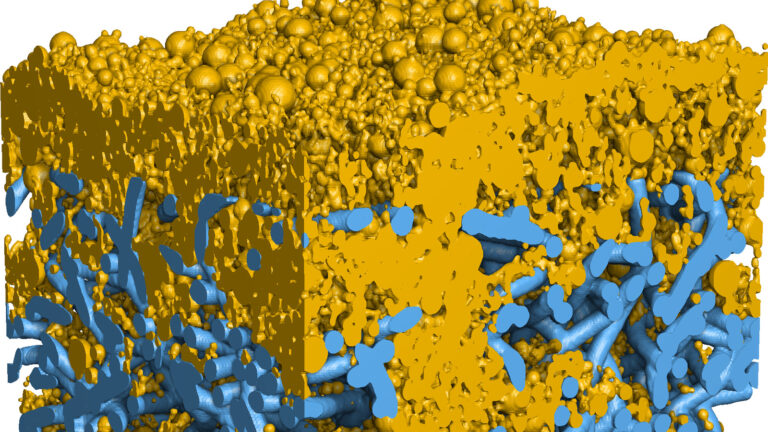
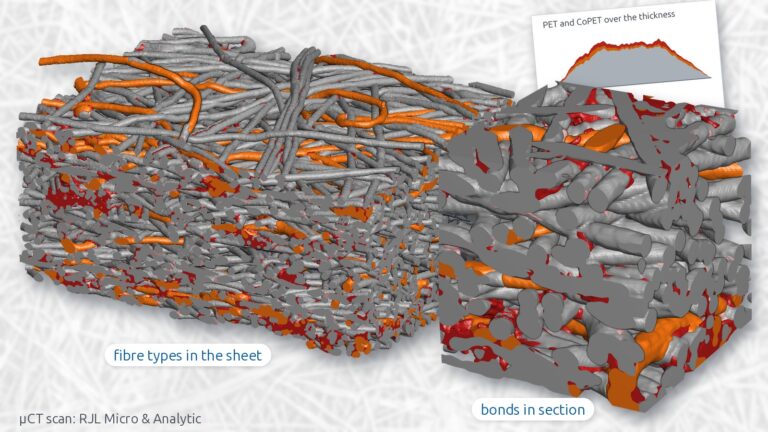
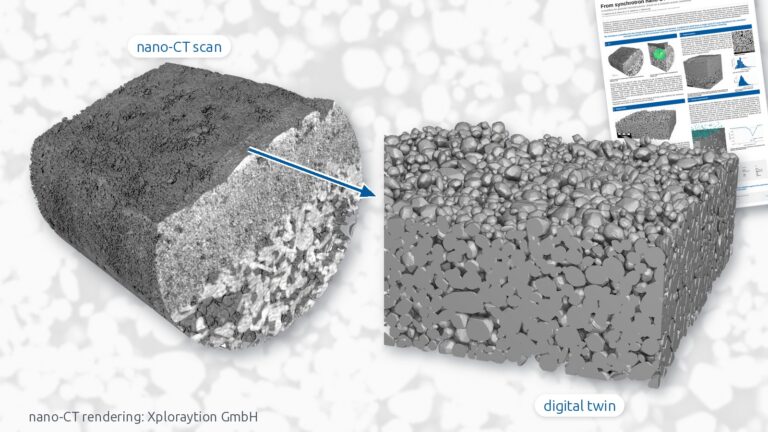
Case studies with pictures and results:
Simulation studies as a service
cvt engineering runs such studies as a service, from a single question on one medium to a development project. Teams that work with GeoDict themselves can apply the GeoDict Copilot in a pilot project or build their own agents with cvt engineering, see AI agents for GeoDict and simulation software.
Related pages: Digital development of porous transport layers (PTL) for PEM electrolysis, Digital twins of ceramic membrane coatings from nano-CT, Research project Osires: filters for injection moulding with recyclates