Ceramic membranes are used more and more in drinking water treatment and wastewater reuse. Their performance is set in the separating layer, a thin coating of sintered ceramic grains, and a new coating is developed by making and testing: each variant has to be coated and fired before it can be judged.
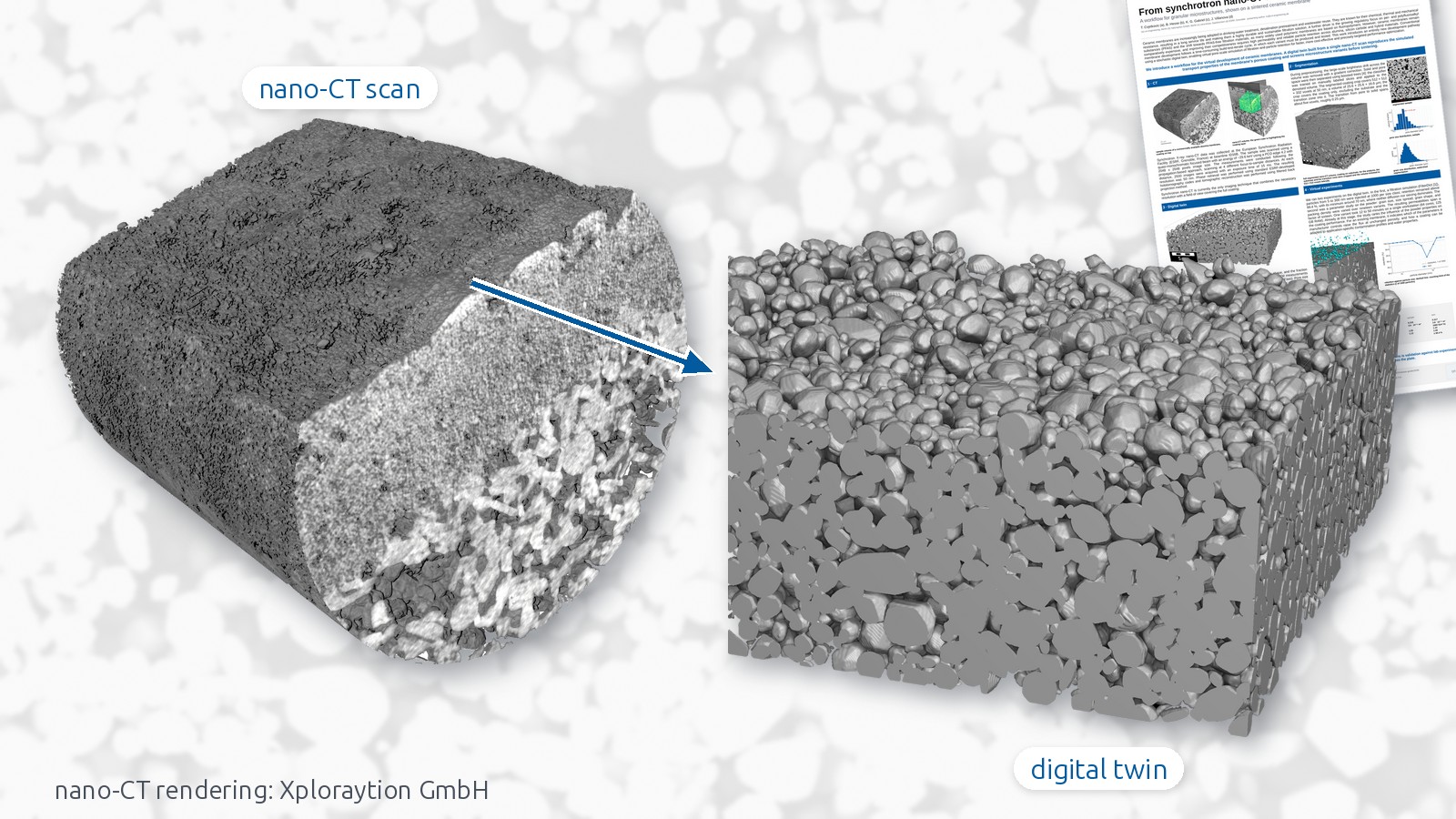
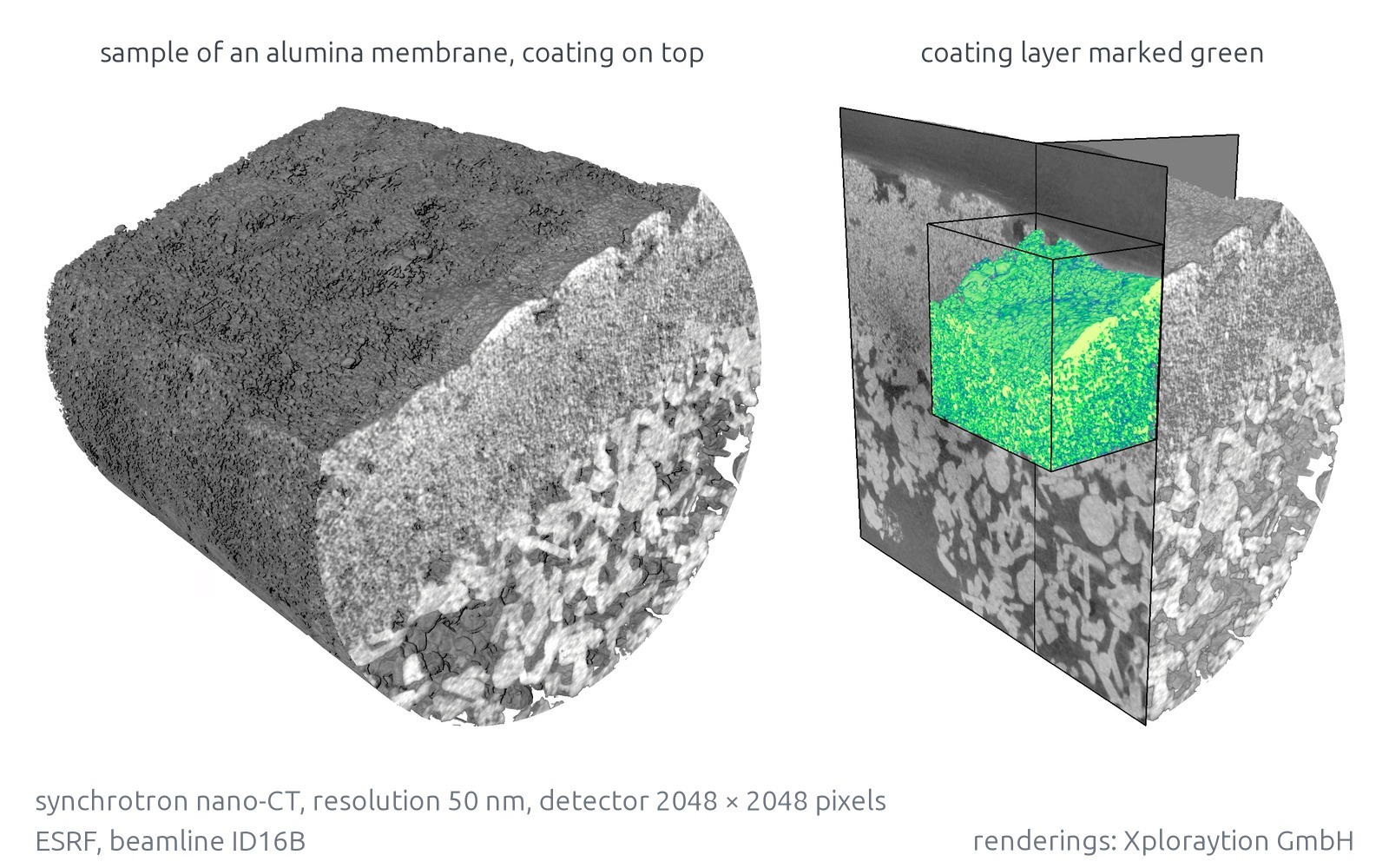
The pores of such a layer are smaller than a micrometre, too small for laboratory micro-CT. With synchrotron nano-CT they are resolved in a field of view that covers the whole coating, and the sample stays intact. From one such scan of a commercially available alumina membrane, a digital twin of the coating was built in GeoDict, and variants of the powder were computed on the coating model in under an hour each. The scan was made by Xploraytion at the ESRF in Grenoble, and the SEM images and the membrane practice came from CERA-KNOW Consulting.
Scan and analysis
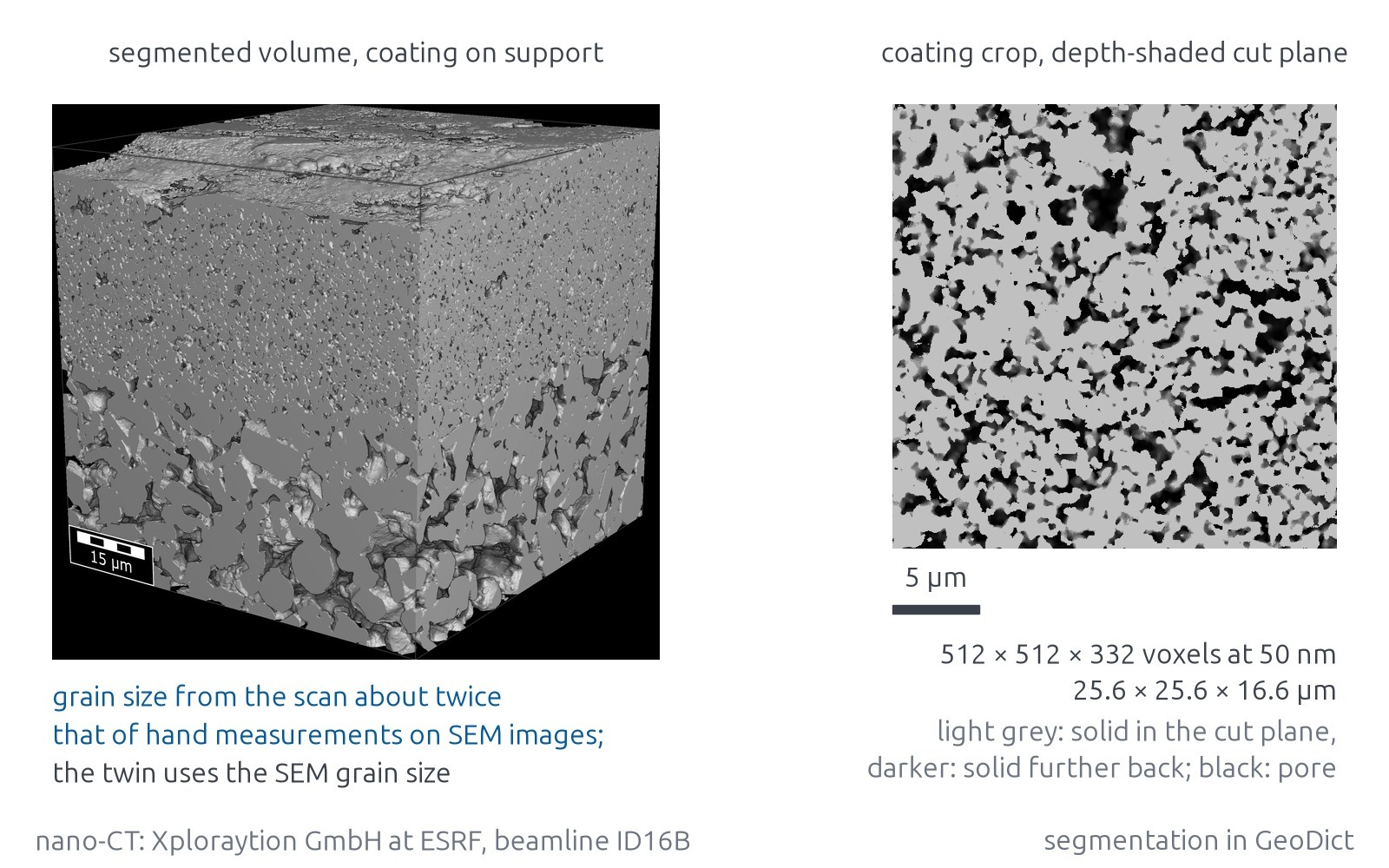
A small piece of the membrane was scanned by holotomography at beamline ID16B of the ESRF, with coating, transition zone and support in one volume. Pore and solid were separated by a machine learning classifier, and porosity, pore sizes and permeability were computed on the coating alone. Grains that have grown together count as one in the scan, so the grain size of the twin comes from hand measurements on SEM images of the coating.
Digital twin of the coating
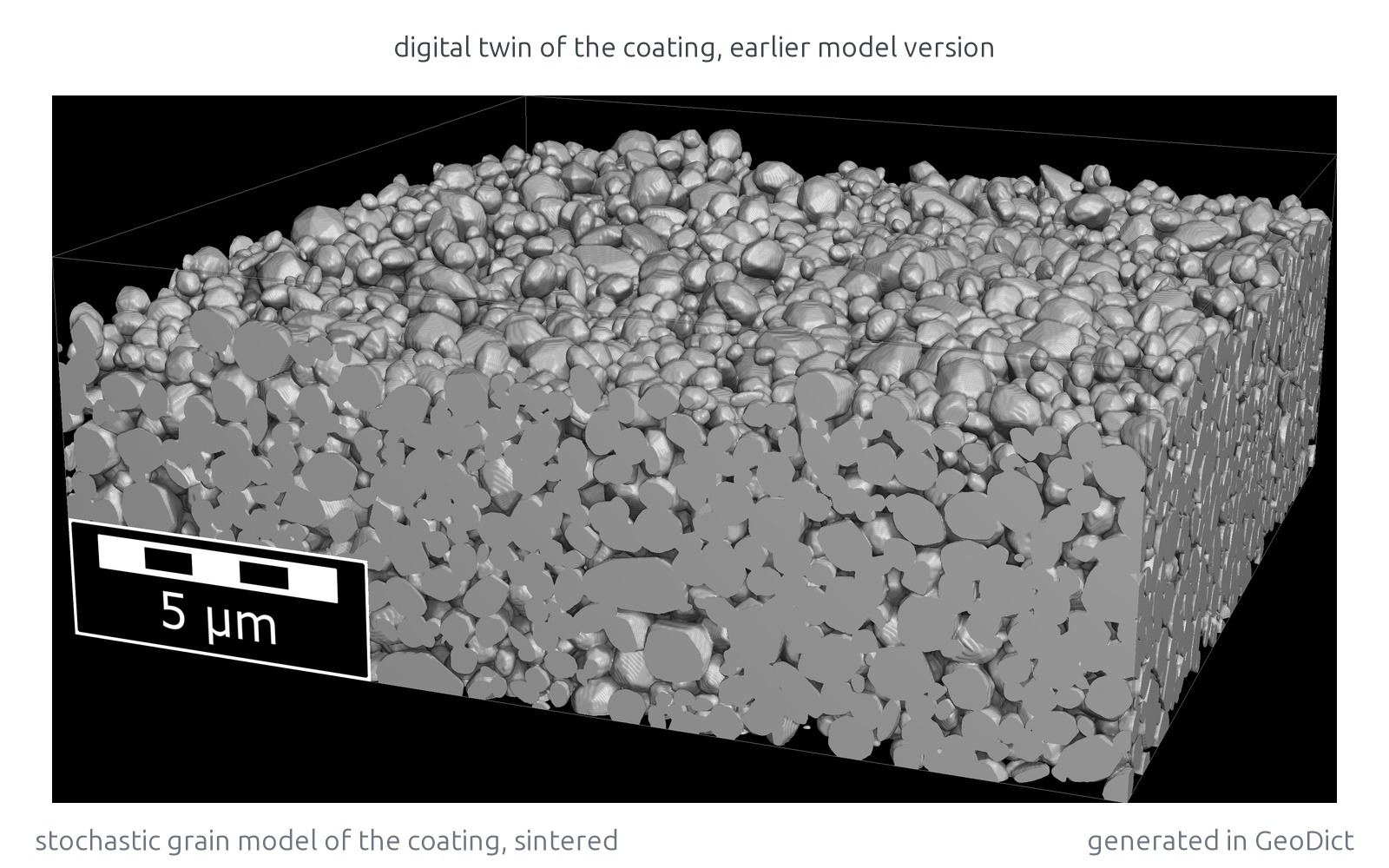
The twin is a parameterized model of the coating generated in GeoDict: two grain populations with sizes and shapes from the SEM images, packed and sintered, with the local density variation measured in the scan. Its single adjusted parameter, the sintering shrinkage, was calibrated against the porosity and the permeability computed on the scan.
Twin and scan compared
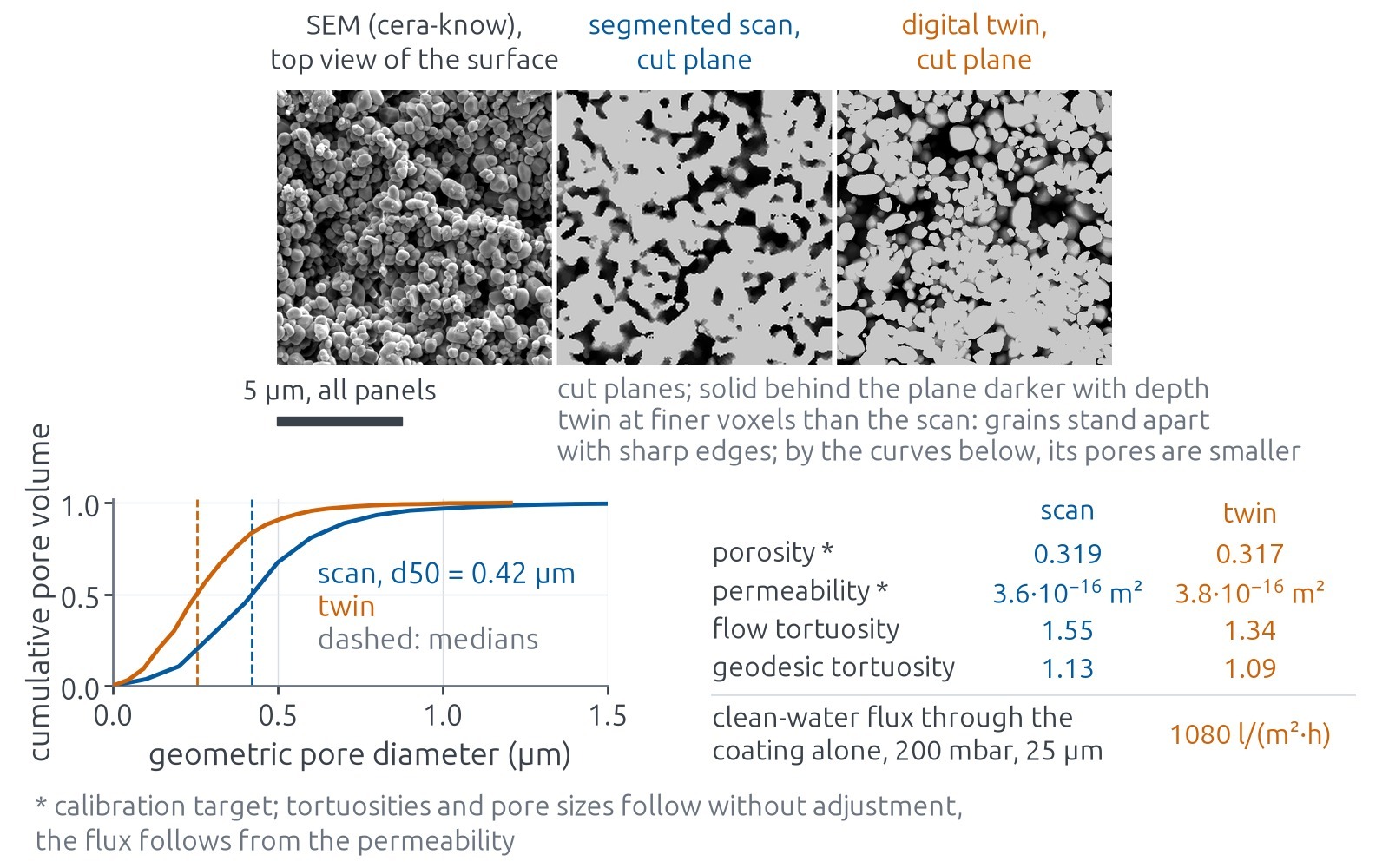
Porosity and permeability of twin and scan agree, as the calibration requires. The pores of the twin are smaller than those of the scan and its flow paths are straighter; the cause of the difference in pore size is open.

Variants of powder and packing
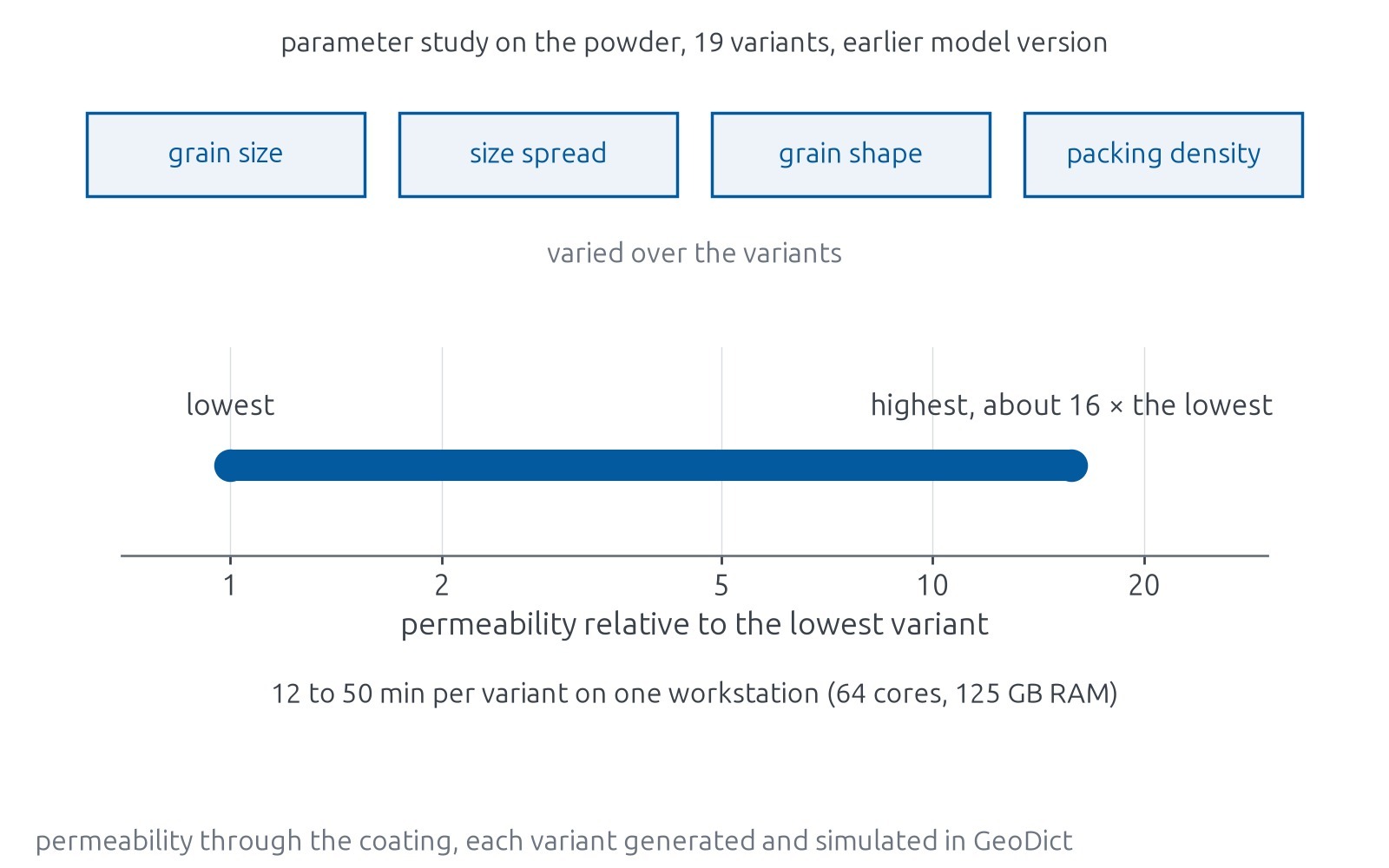
With the coating model, grain size, size spread, grain shape and packing density were varied over nineteen variants. Their permeabilities span a wide range, and each variant was generated and simulated on one workstation in under an hour. The study and the renderings come from an earlier version of the model.
Filtration
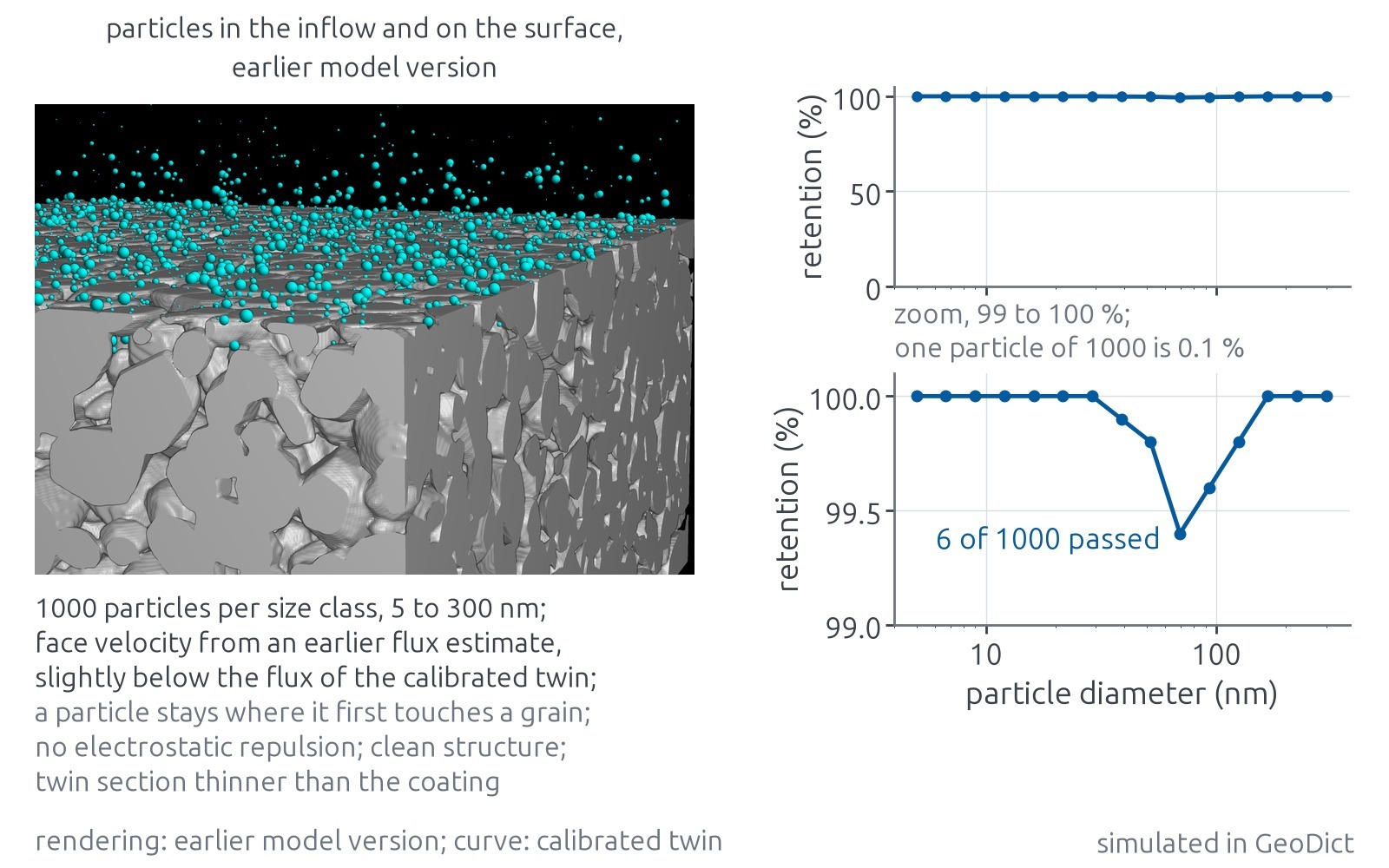
Particles from a few nanometres to a few hundred nanometres were sent through the twin. Retention stays close to complete over the whole range and is lowest in the middle of it. In the simulation a particle stays where it first touches a grain, so every value is an upper limit.
Use in coating development
Pore sizes and tortuosity of a coating in three dimensions, which bubble point, porometry and permeability tests do not give, follow from one scan of a sample. The parameter study shows how far powder and packing change the permeability of a coating before a batch is made. Once the model is validated against laboratory values, variants can be ruled out before slurries are mixed and plates are fired.
Limits
The twin is built from one scan at one place of one membrane. It is calibrated to the scan and has not yet been validated against laboratory measurements of the same membrane, which is the next step.
Digital twins of ceramic membranes
cvt engineering offers the analysis of a nano-CT scan of a coating sample and the digital twin with its variants, together with cera-know for the membrane side and Xploraytion for the scans. The work was shown at the ToScA 2026 conference in Thessaloniki, on the poster “From synchrotron nano-CT to stochastic digital twin” by T. Cvjetkovic (cvt engineering), B. Hesse (Xploraytion GmbH), K. G. Gabriel (cera-know) and J. Villanova (ESRF), with analysis and simulations in GeoDict, the software of Math2Market.