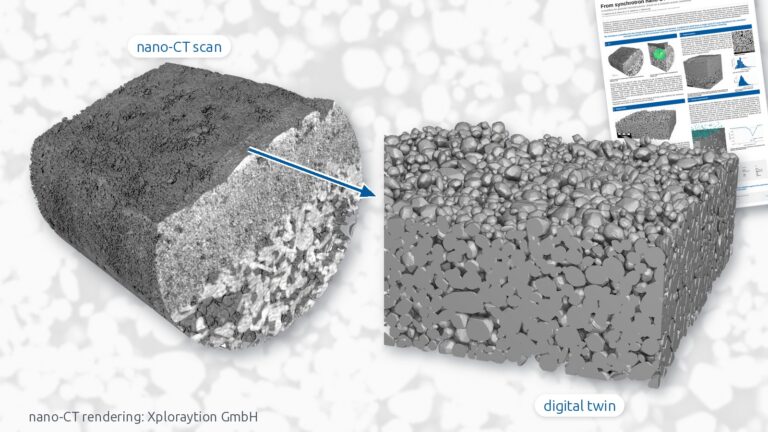
The separating layer of a ceramic membrane is a thin coating of sintered ceramic grains, and a new coating is developed by applying and firing each variant before it can be judged. With synchrotron nano-CT its sub-micrometre pores, too small for laboratory micro-CT, are resolved across the whole coating without destroying the sample. From one such scan a digital twin of the coating is built in GeoDict, the software for digital material R&D by Math2Market; the twin is a parameterized model in which powder and packing can be varied.
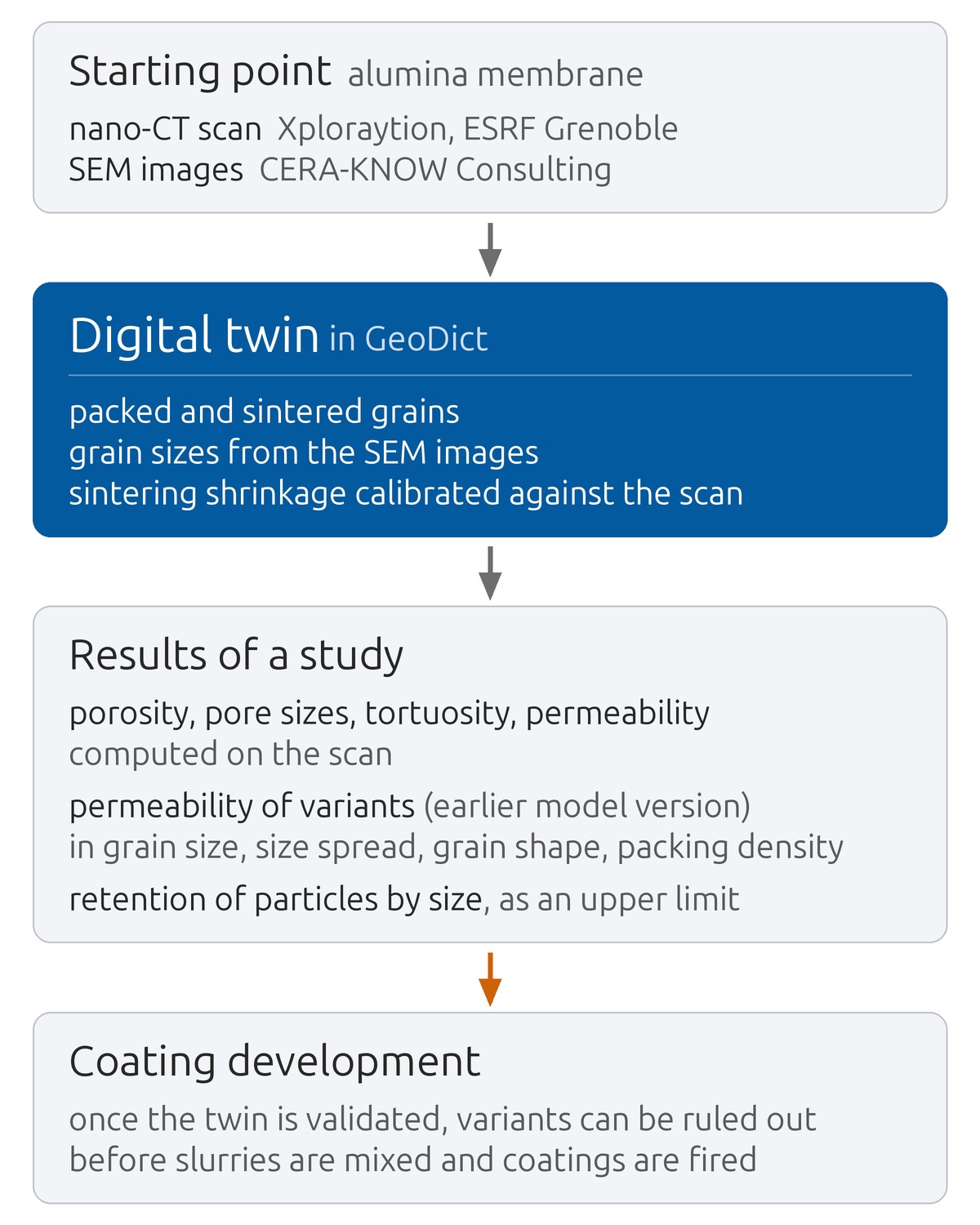
Results of a study
- Porosity, pore sizes, tortuosity and permeability of the coating, computed on the scan.
- Permeability of variants in grain size, size spread, grain shape and packing density, on an earlier model version.
- Retention of particles by size, computed on the twin as an upper limit.
Scan and twin
The scan of a commercially available alumina membrane was made by Xploraytion at the ESRF in Grenoble, and the SEM images and practical membrane knowledge came from CERA-KNOW Consulting. The twin is a GeoDict model of packed and sintered grains with grain sizes from the SEM images, and its sintering shrinkage is calibrated against the scan. Porosity and permeability of twin and scan agree, as the calibration requires; the pores of the twin are smaller, and the cause is open. The twin comes from one scan of one membrane and has not yet been validated against laboratory measurements.
Conditions and use
In a study on an earlier model version, nineteen variants differed widely in permeability, each computed on one workstation in under an hour. Once the twin is validated, variants can be ruled out before slurries are mixed and coatings are fired.
Examples
Case study with pictures, video and results:
Digital twins of ceramic membranes
cvt engineering offers the analysis of a nano-CT scan of a coating sample and the twin with its variants, together with CERA-KNOW Consulting and Xploraytion.
Related pages: AI-assisted development of filter media and nonwovens, Digital development of porous transport layers (PTL)