
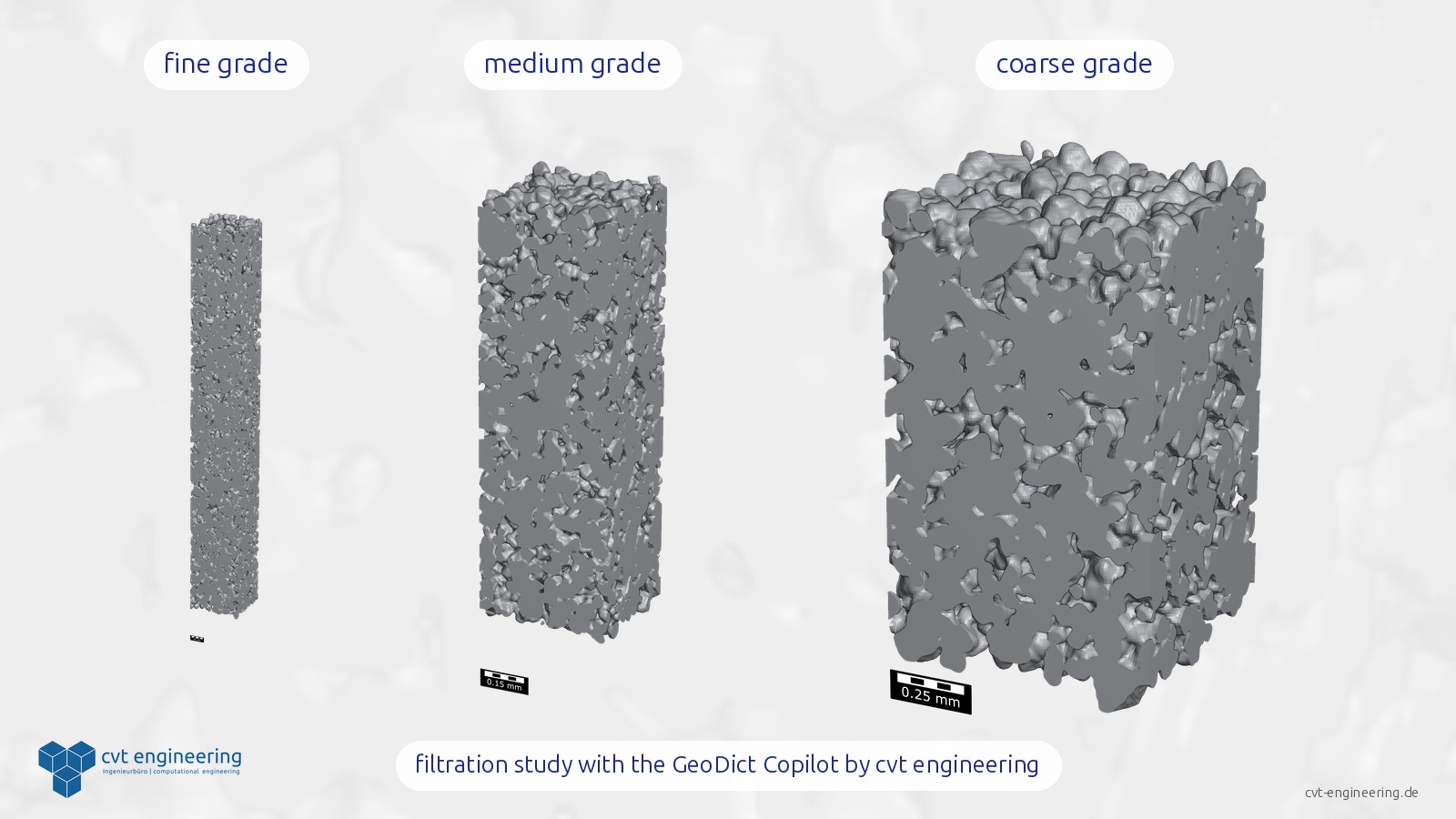
This case study looks at how well three sintered metal filter grades capture two test dusts, and how deep the dust gets into the filter. The simulations ran in GeoDict. The macros and the report were written by the GeoDict Copilot, the AI agent that cvt engineering develops for GeoDict.
The simulation
Three filter grades, fine, medium and coarse, were generated in GeoDict as sintered grain structures. Air flows through each of them, carrying a fine and a coarse test dust, each with its full size distribution. For every grade the simulation gives the filtration efficiency per particle size and the depth at which the particles are caught.
The Copilot’s part
The Copilot wrote and ran the GeoDict macros, evaluated the results and built the report.
Limits of the study
The filter structures are generic and built from assumed powder sizes. No manufacturer data and no measurement stand behind the numbers. In the model a particle sticks at its first contact with a grain. Where the report shows complete capture for a particle size, none of the tracked particles of that size passed the filter.
Made with the GeoDict Copilot
The GeoDict Copilot is an AI agent for GeoDict. It writes and runs GeoDict macros, evaluates the results and documents what it did.