Titanium fibre felt and sintered titanium powder are the two common designs of the porous transport layer (PTL) in a PEM water electrolyser and PTL designs are compared by testing a cell with each candidate. With microstructure simulation in GeoDict, the software for digital material R&D by Math2Market, pore sizes, permeability, conductivity, the contact with the catalyst layer and the gas breakthrough are computed on one 3D structure of the layer, from a µCT scan of a sample or from design data before a sample exists.
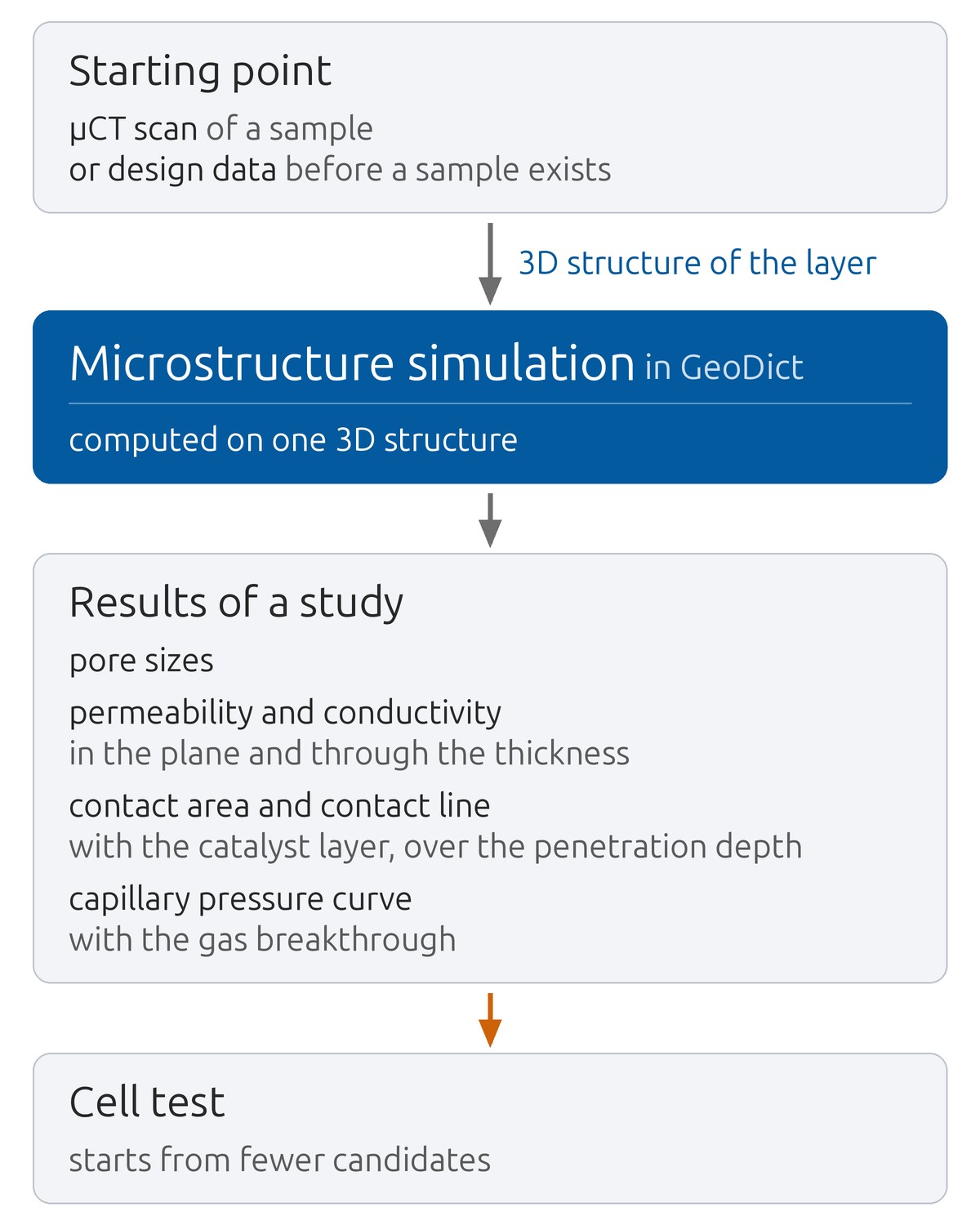
Results of a study
- Pore sizes, water permeability and electrical conductivity, in the plane and through the thickness.
- Contact area and contact line with the catalyst layer over the penetration depth.
- Capillary pressure curve with the gas breakthrough.
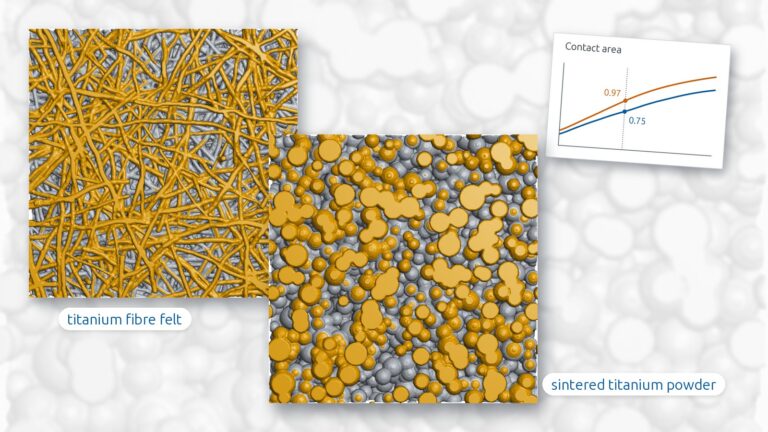
Felt and sintered powder
Two virtual layers were generated from published parameters and differ in porosity and thickness as well as in design; no result has been validated against a measurement. The felt has the wider pores, the higher permeability and the lower breakthrough pressure, the sintered powder the better through-plane conduction and the larger contact area. In a published series of six titanium felts and one sintered powder, cell performance correlated with the contact area, and permeability showed no measurable correlation as long as the pores were wide enough. The computed resistance across both layers lies far below the contact resistance measured in cells, and whether the finding holds for sintered powders is open.
Use in development
Variants can be computed before they are made, so one that gains contact area but narrows its pores towards a pore size threshold is recognised early, and the cell test starts from fewer candidates.
Examples
Case study with pictures and results:
Analysis of porous transport layers
cvt engineering offers these analyses for PTLs and other porous layers of electrolysers and fuel cells. The study was made with the GeoDict Copilot, the AI agent that cvt engineering develops for GeoDict.
Related pages: AI-assisted development of filter media and nonwovens, Digital twins of ceramic membrane coatings