At the GeoDict Innovation Conference 2026 I gave a live demo of the GeoDict Copilot, the AI agent I develop for GeoDict at cvt engineering. One request was a battery cathode particle made of small sintered grains.
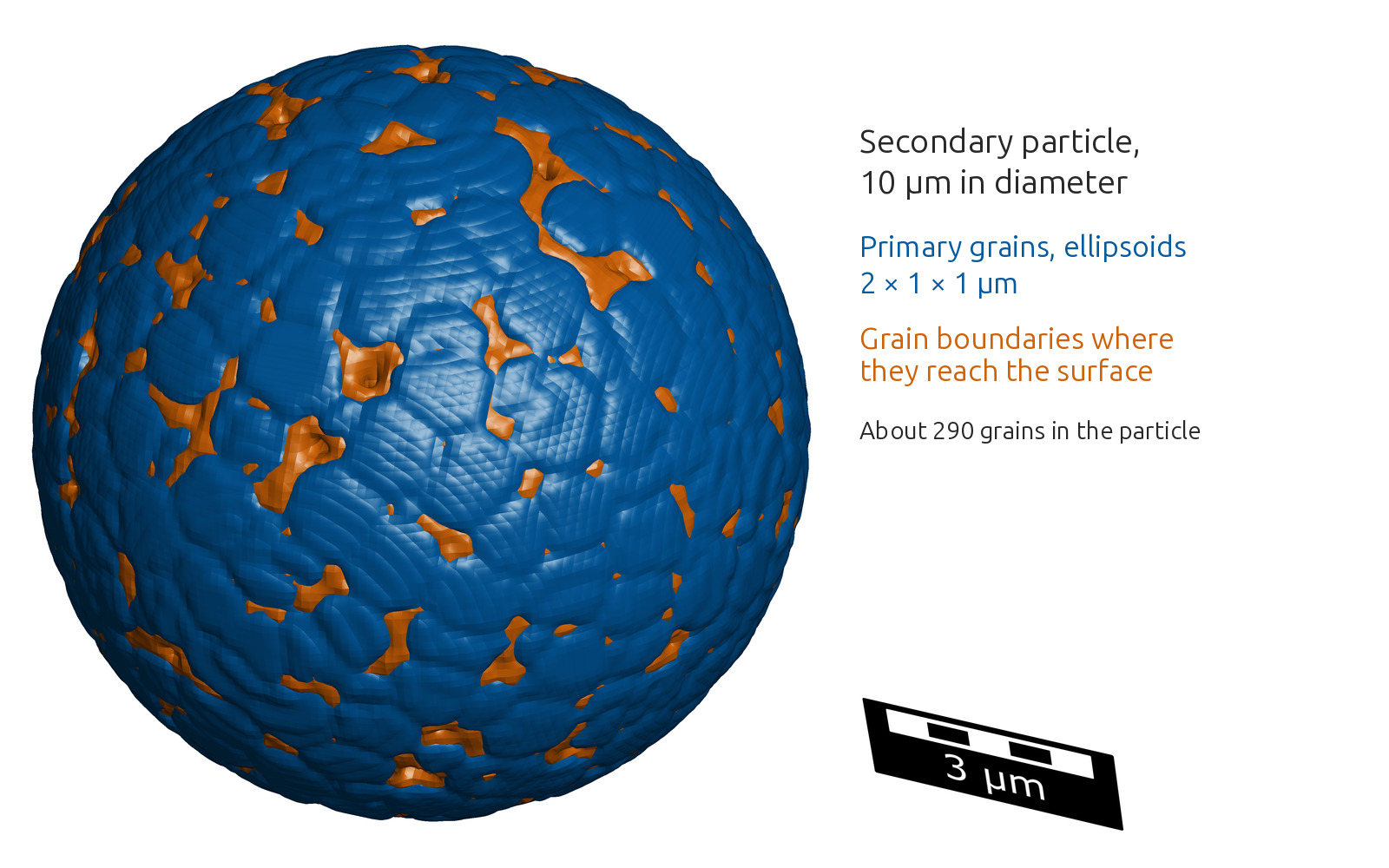
Secondary particles of nickel-rich layered cathodes such as NMC are agglomerates of smaller primary grains (Lee et al., Advanced Science, 2019). For rod-shaped grains packed radially, less tortuous lithium pathways and a better capacity retention than with randomly oriented grains were reported (Xu et al., Nature Communications, 2020), and radially aligned grains were reported to suppress microcracks (Park et al., Advanced Energy Materials, 2021). The particle here has this radial form.
Grain orientation in GeoDict
GeoDict, the simulation software by Math2Market, piles and sinters grains with one orientation distribution per grain type. An orientation that depends on the position of a grain is not among its documented options, so a script has to turn the grains.
Building the particle
I accepted the steps, grain size and solid content the Copilot proposed. The first version had round grains, so I asked for ellipsoids with their long axes pointing to the centre and suggested turning them in GeoDict’s geometry file.
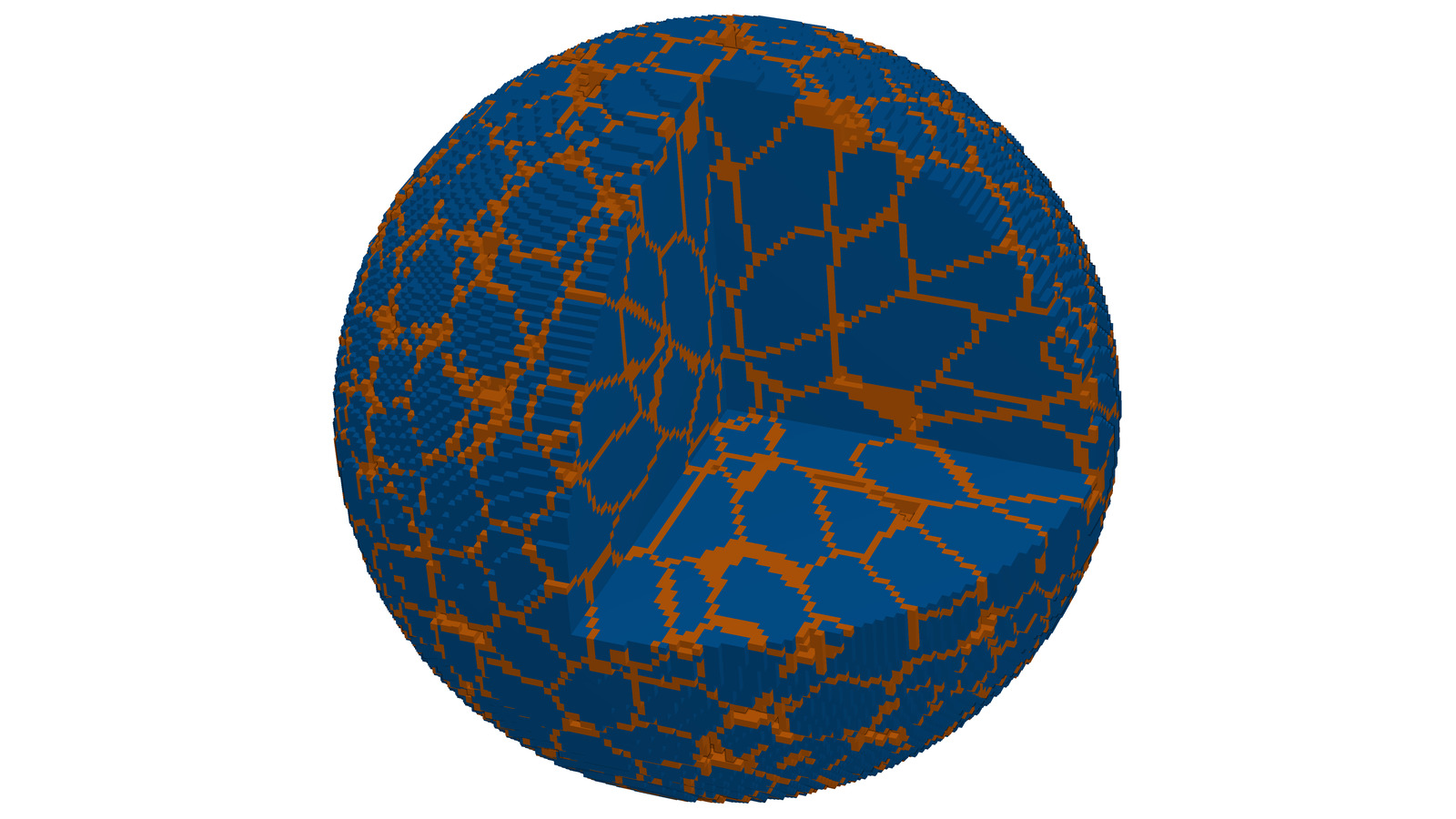
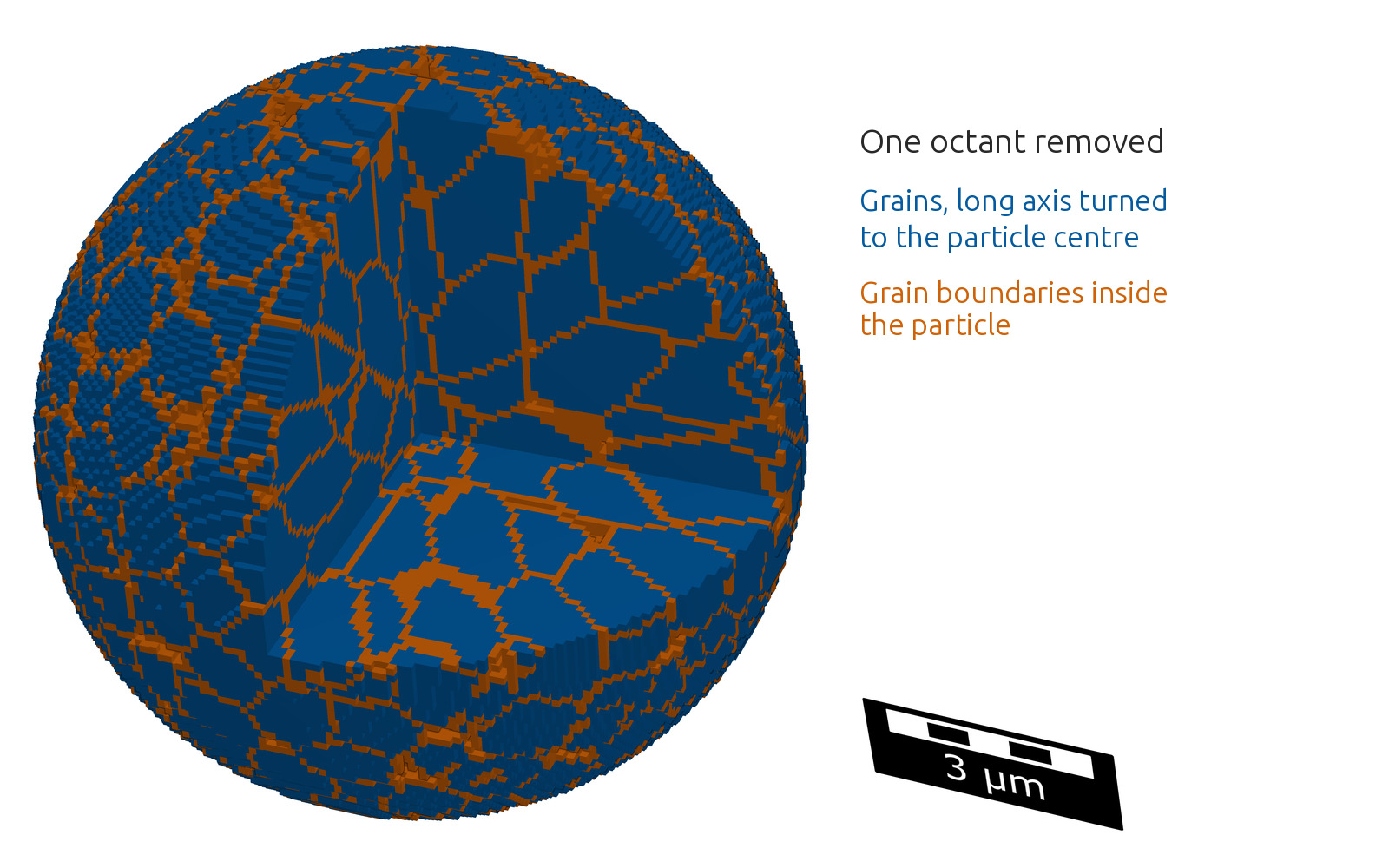
The Copilot chose the aspect ratio, wrote the macro and ran it. The ellipsoids are piled in a periodic cube, turned to the centre and sintered to a high solid content, with the grain boundaries as a separate material. Then a sphere is cut out. One job failed. About twenty minutes after my first request the particle was open in GeoDict.
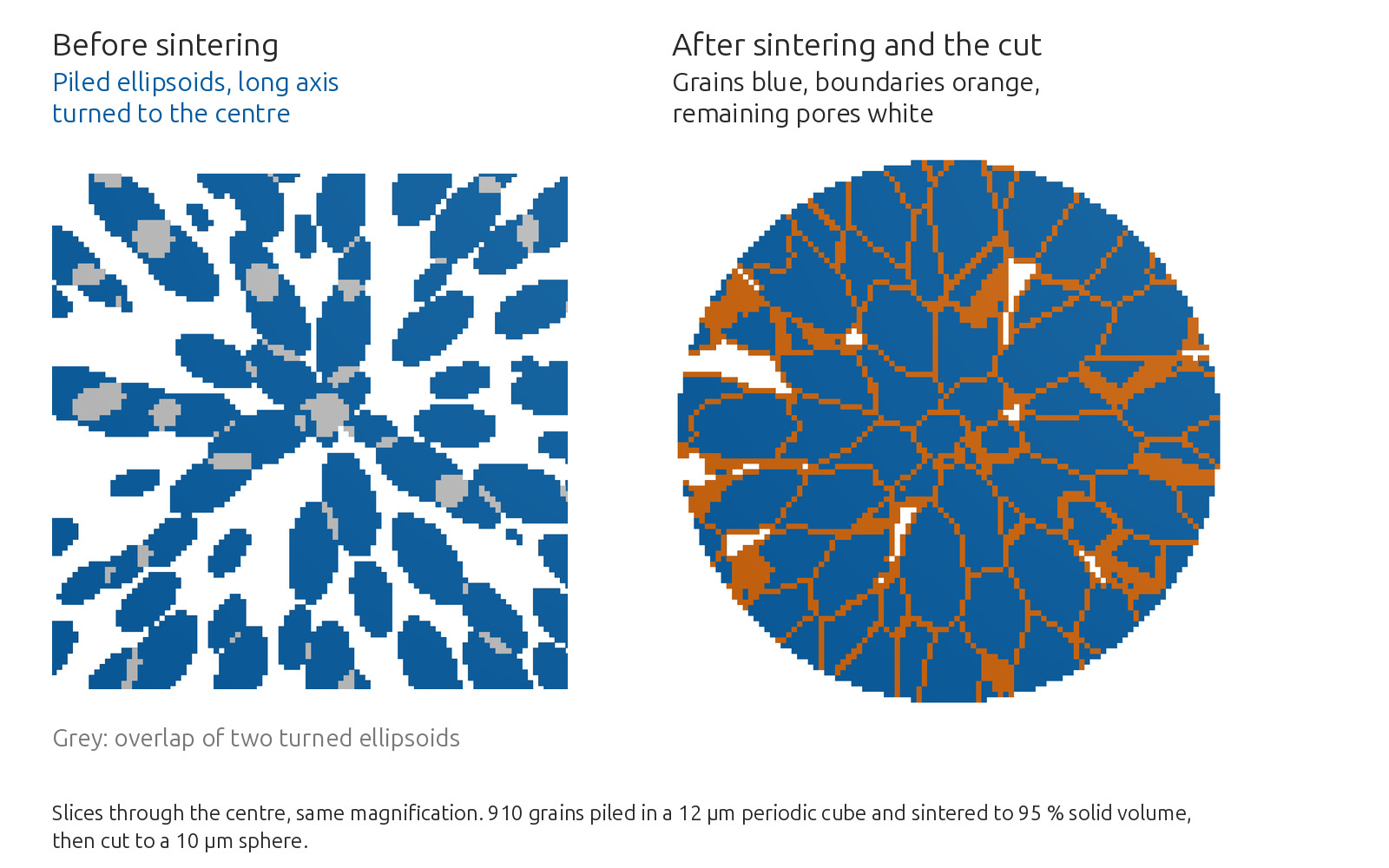
Variants of the particle
Particle size, grain size, aspect ratio and solid content are variables of the macro, so variants are a series of runs. The model keeps grains and grain boundaries apart, which simulations of conduction or mechanics across the boundaries need.
Limits
This is a geometric model with sizes set in the session, without a measured or published source. The grains are named NMC and carry GeoDict’s default material values. Nothing has been simulated on it yet.
Custom structures in GeoDict
cvt engineering builds such structures from a customer’s parameters and simulates conduction and mechanics on them.