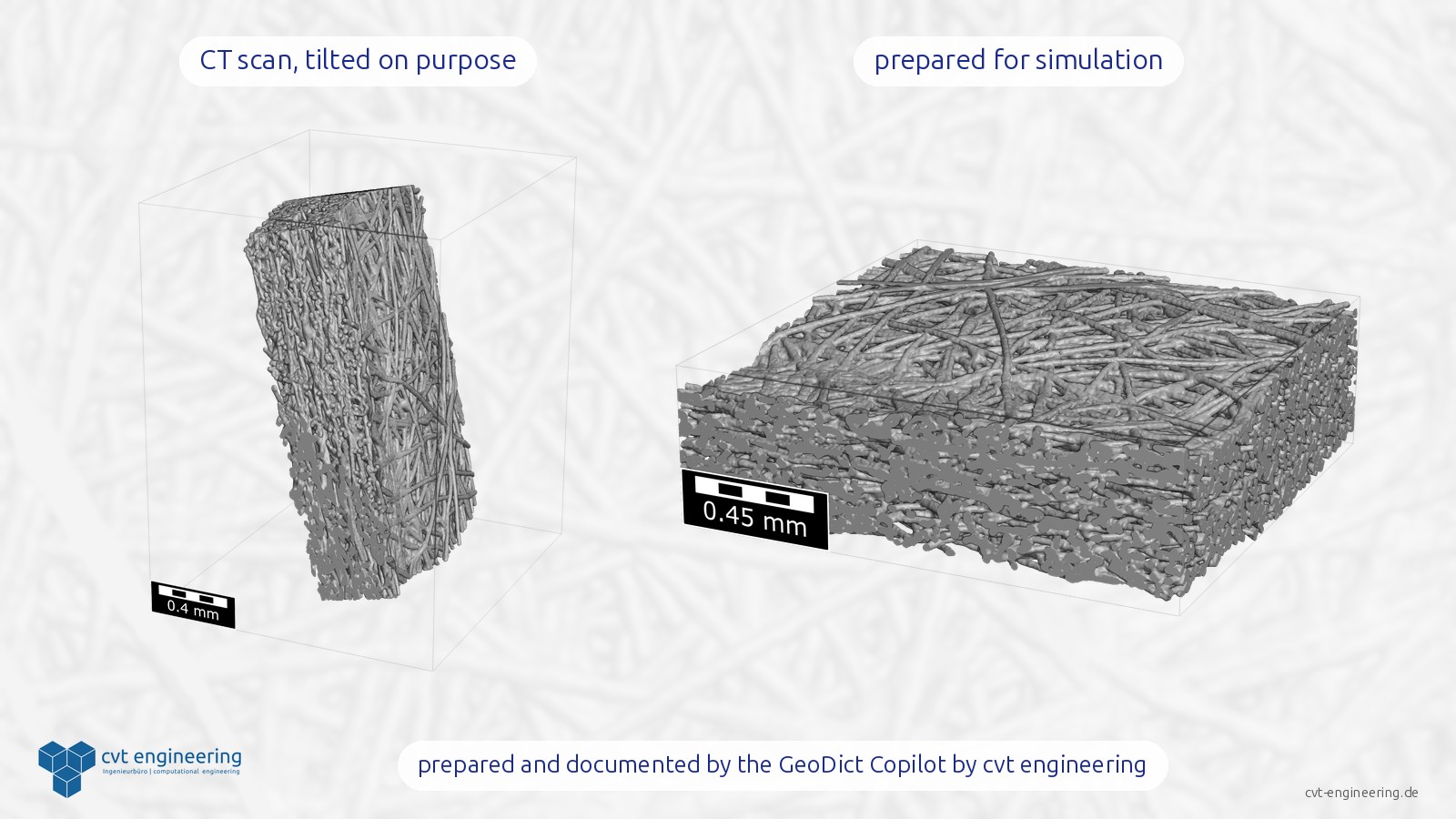
A segmented CT scan of a nonwoven is rarely ready for simulation. The sheet can lie tilted and turned in the image, its borders are frayed, and there is empty space above and below it. Here the GeoDict Copilot, the AI agent that cvt engineering develops for GeoDict, prepares such a scan and documents its steps.
The scan
The sample is a commercial PET/CoPET bicomponent spunbond filter medium. RJL Micro & Analytic scanned it in a µCT for cvt engineering. For this test the image stack was turned about all three axes before segmentation, so the tilt of the sheet is deliberate and its angles are known.
The preparation
The Copilot measures before it changes anything, and it saves the result of each preparation step as a new file. It puts the thickness of the sheet on the z axis, removes the tilt and the turn about z, and cuts away the frayed borders and the empty space. Two structures come out, one for a flow simulation through the sheet and one for geometric properties such as porosity and pore sizes. The report gives each decision together with the measurement behind it.
The voxel length
The scan file carried a voxel length far too small for a nonwoven. The Copilot reported the value as implausible when it read the file and proposed a plausible one. The engineer confirmed it, and the Copilot corrected the file and kept the original as a copy. The report states the voxel length that was set.
Limits
The procedure was developed on this scan and has not been shown on a scan from another source. The scan comes in already segmented, and the segmentation is not part of the preparation.
Made with the GeoDict Copilot
The GeoDict Copilot is an AI agent for GeoDict. It writes and runs GeoDict macros, evaluates the results and documents what it did.